
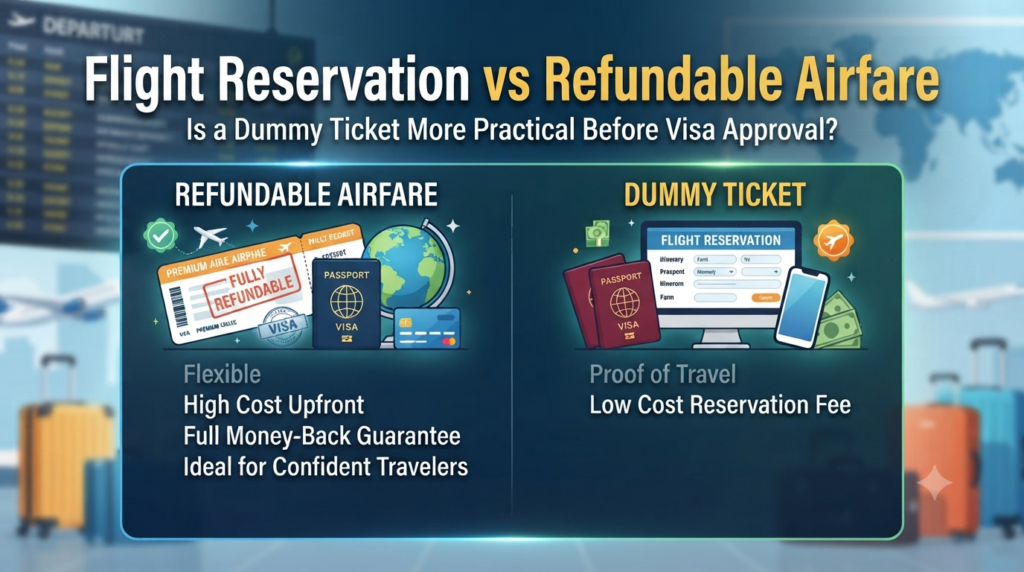
Applying for a visa often involves arranging several travel documents before you know whether your application will be approved. One common question is whether you should purchase a refundable flight ticket or use a Dummy Ticket that provides a proposed travel itinerary without committing to an expensive airfare.
The practical answer depends on your destination country’s visa requirements, your travel dates, your budget, and how much flexibility you need. A refundable ticket offers a confirmed booking with specific cancellation conditions, while a reservation-based itinerary may help demonstrate your proposed travel plans without paying the full ticket price.
Both options have advantages, but neither guarantees visa approval. Understanding the difference between them can help you prepare a more sensible application and avoid unnecessary financial risk.
Let’s compare flight reservations, refundable airfare, and the role of a Dummy Ticket for Visa applications so you can make an informed decision before booking your trip.
What Is a Dummy Ticket and How Does It Work?
A Dummy Ticket is a flight itinerary used to show proposed travel arrangements, usually including the passenger’s name, flight route, travel dates, and reservation details.
It is commonly considered by travellers who need to provide flight information during a visa application but don’t want to purchase a non-refundable airline ticket before receiving a decision.
However, the term can describe different types of documents. Some are genuine airline reservations held temporarily, while others may be itinerary documents generated through travel service providers. Their validity and acceptance can differ.
What information does a dummy air ticket usually contain?
A legitimate flight reservation or itinerary may include:
-
- Passenger’s full name
-
- Departure and arrival airports
-
- Proposed travel dates
-
- Airline and flight numbers
-
- Connecting flight information, if applicable
-
- Booking reference or reservation details, where available
- Reservation status and validity information
The information should be consistent with the travel dates and purpose explained in your visa application.
Is a dummy ticket the same as a confirmed flight ticket?
No.
A reservation or itinerary doesn’t necessarily mean that an airline ticket has been issued and paid for. A confirmed, ticketed booking is different from a temporary reservation.
You should understand exactly what you’re receiving before using it for an application. Never describe a temporary reservation as a fully paid ticket if it isn’t one.
Flight Reservation vs Refundable Airfare: Understanding the Difference
The two options serve a similar purpose during visa preparation, but their financial commitments are quite different.
A flight reservation may provide proposed travel details without requiring you to purchase the full airfare. A refundable ticket, on the other hand, involves buying an actual ticket and accepting the airline’s cancellation and refund conditions.
Here’s a practical comparison.
| Comparison factor | Flight reservation | Refundable airfare |
| Initial payment | May be free or involve a service fee | Requires payment of the ticket price |
| Ticket issuance | May not be ticketed | Normally issued after purchase |
| Financial commitment | Usually lower | Usually higher |
| Cancellation | Depends on reservation type and validity | Subject to fare rules |
| Refund | Depends on whether a fee was paid | Depends on airline conditions |
| Validity | May expire after a limited period | Remains subject to ticket conditions |
| Visa documentation | Depends on embassy requirements | Can provide proof of an issued ticket |
| Flexibility | Useful before finalising travel plans | Depends on refund and change conditions |
The biggest difference is financial exposure.
If your visa application is still under review, paying for a refundable ticket may tie up a significant amount of money. A genuine flight reservation can be more practical when the relevant visa authority accepts it.
However, don’t assume that every embassy accepts every type of reservation. Always check the official checklist for your visa category.
Why Travellers Consider a Dummy Ticket for Visa Applications
Many visa applicants are uncomfortable purchasing expensive flight tickets before receiving a decision.
Imagine you’re applying for a Schengen tourist visa from India. Your proposed trip is scheduled for 15 June, but your application decision may arrive only a few weeks before departure.
If you purchase flights immediately, you could face cancellation charges or refund delays if your application is refused or delayed.
This is one reason applicants explore a Dummy Ticket for Visa purposes.
Avoid committing to expensive airfare too early
International flights can cost a substantial amount, especially during peak travel seasons.
A reservation-based itinerary may help you present your intended travel schedule without paying the entire ticket amount upfront, provided the consulate accepts that type of document.
Keep travel plans flexible
Visa processing times aren’t always predictable.
An applicant may need to adjust travel dates because of:
-
- Additional document requests
-
- Delayed appointments
-
- Longer processing periods
-
- Changes in personal circumstances
-
- Uncertainty about the visa decision
A temporary reservation can be useful during the planning stage, but its validity must be checked. An expired itinerary may no longer reflect an active booking.
Reduce the risk of cancellation expenses
A refundable ticket can protect you from losing the full airfare, but refund conditions still matter.
Some tickets have cancellation fees, administrative charges, or restrictions. Refunds may also take time to process.
A suitable reservation can reduce the need for a large upfront payment when an actual ticket isn’t required at the application stage.
When Is Refundable Airfare the Better Option?
Although reservations can be practical, refundable airfare isn’t automatically a poor choice.
There are situations where purchasing a ticket makes more sense.
When the embassy specifically requires a ticket
Some visa categories or authorities may ask applicants to provide a confirmed, issued ticket or proof of paid travel arrangements.
If the official instructions clearly require a ticket, a temporary reservation may not satisfy the requirement.
Read the checklist carefully. If the wording is unclear, contact the relevant embassy, consulate, or authorised visa application centre.
When your travel dates are fixed
Suppose you’re attending a conference in London on 20 August and your employer has already approved your leave.
If you need to travel on specific dates, purchasing a suitable refundable ticket may provide greater certainty.
The decision should still account for visa processing time and cancellation rules.
When you find favourable refundable fare conditions
Some airlines offer flexible fares with relatively reasonable cancellation terms.
Before purchasing, check:
-
- Whether cancellation is permitted before departure
-
- Whether the refund is monetary or issued as travel credit
-
- Whether taxes and surcharges are refundable
-
- Whether cancellation fees apply
-
- How long the refund may take
-
- Whether changes are allowed without a fee
Don’t rely on the word “refundable” alone. Read the fare conditions attached to the exact ticket.
How to Choose Between a Flight Reservation and a Refundable Ticket
The right option depends on your circumstances rather than a universal rule.
Before deciding, consider these five factors.
1. Check the visa authority’s requirements
Start with the official visa checklist.
Different countries, visa categories, and application circumstances can have different documentation requirements.
Some authorities accept a proposed itinerary or reservation. Others may request a confirmed ticket or additional proof.
Don’t base your decision solely on advice from a travel agent, social media post, or online discussion.
2. Consider your travel budget
Calculate how much money you would need to pay upfront.
For example, imagine a return flight costs ₹65,000. A refundable fare may require you to pay the full amount before the visa decision.
If your application is refused, you may need to wait for the refund and could lose money depending on the fare rules.
A legitimate reservation service may involve a much smaller expense, but only use it if the relevant authority accepts the document.
3. Evaluate your travel dates
If your travel dates are tentative, a temporary reservation may be more practical.
If you have fixed travel dates and a clear requirement for a ticket, a refundable fare may be worth considering.
Remember that reservations can expire. The document should accurately represent the booking status when submitted and whenever the authority asks you to provide updated information.
4. Understand cancellation and refund conditions
A refundable ticket isn’t necessarily a completely risk-free purchase.
Review the fare rules and understand the difference between a full refund, a partial refund, and airline credit.
Similarly, check whether a reservation is genuinely held by an airline, how long it remains valid, and whether it can be verified.
5. Keep your complete visa application consistent
Your flight itinerary should match the rest of your application.
For example, if your cover letter says you’re travelling for 12 days, your proposed arrival and departure dates should make sense alongside your accommodation and travel plan.
Consistency helps the visa officer understand your intended trip.
What Makes a Dummy Air Ticket Suitable for Visa Documentation?
Not every itinerary document is appropriate for visa submission.
The important question isn’t simply whether the document looks professional. It should accurately represent a genuine reservation or proposed travel arrangement and meet the requirements of the relevant visa authority.
Accurate passenger information
Your name should match your passport.
Even small spelling differences can create confusion, particularly when the document is compared with other application records.
Check your name, route, travel dates, and other passenger information before using the itinerary.
Clear flight details
The document should provide enough information for the visa officer to understand your proposed journey.
Depending on the reservation type, this may include airline details, flight numbers, departure and arrival airports, and connecting flights.
Verifiable reservation information
If a booking reference is provided, understand what it represents.
A reservation reference should correspond to the actual booking and its current status. It should not be invented or presented as proof of a ticket that was never issued.
A temporary reservation may expire or become inactive, so check its status before submission.
Travel dates that support your application
Choose dates that align with your intended travel period.
For example, if you’re requesting a 15-day tourist visa, an itinerary showing a two-month stay may create unnecessary questions unless your application clearly explains the arrangement.
Your itinerary should reflect a realistic travel plan rather than an arbitrary flight schedule.
Common Mistakes to Avoid When Submitting Flight Reservations
A flight document is only one part of a visa application. Mistakes can create inconsistencies or raise questions about the credibility of your travel plans.
Here are some common issues to avoid.
1. Submitting an expired reservation
Temporary reservations may have limited validity.
If the booking has expired, the document may no longer represent an active reservation. Check the current status before submitting it.
2. Using fabricated booking details
Never use an invented booking reference, false airline confirmation, or altered document that misrepresents the actual reservation.
False or misleading information can result in visa refusal and potentially more serious consequences.
3. Ignoring the official visa checklist
A reservation that works for one visa category may not be suitable for another.
For instance, tourist, business, student, and family visit applications may have different supporting-document requirements.
Follow the instructions applicable to your application.
4. Choosing unrealistic travel dates
Your itinerary should make sense alongside your employment leave, accommodation, financial documents, and stated purpose of travel.
Avoid dates that contradict other information in your application.
5. Assuming a reservation guarantees visa approval
A flight reservation doesn’t establish that you meet the visa requirements.
Authorities generally assess several factors, including the purpose of travel, financial circumstances, supporting documents, and eligibility under the relevant immigration rules.
A flight itinerary is supporting evidence, not a guarantee.
Is a Dummy Ticket Accepted by Every Embassy?
No. There is no universal rule that every embassy accepts a temporary flight reservation.
Requirements vary by destination, visa category, and individual application circumstances.
For example, a tourist visa application may ask for a travel itinerary, while another category may require evidence of an issued ticket or specific travel arrangements.
Some authorities also advise applicants not to purchase non-refundable tickets before a visa decision.
The safest approach is to consult the official embassy or immigration website before arranging your flight documentation.
Check the wording carefully
Pay attention to the difference between these terms:
-
- Flight itinerary: A proposed schedule of intended travel.
-
- Flight reservation: A booking or held itinerary that may have limited validity.
-
- Confirmed booking: A reservation accepted by the airline, although it may not necessarily be ticketed.
-
- Issued ticket: An actual ticket issued for the passenger.
-
- Refundable ticket: An issued ticket with refund rights subject to its fare conditions.
These terms aren’t interchangeable.
If the requirement says “flight itinerary,” a reservation may be sufficient. If it specifically says “issued ticket,” don’t assume a temporary reservation will meet the requirement.
How to Arrange a Flight Reservation Before Visa Approval
Once you’ve confirmed that a reservation is suitable for your application, follow a few simple steps.
Step 1: Finalise your proposed travel route
Decide where you’ll depart from, your destination, and whether you need connecting flights.
Make sure the route supports the purpose of your trip.
Step 2: Select realistic travel dates
Use dates that fit your planned stay and the processing timeline.
Leave enough flexibility if your visa decision is still pending.
Step 3: Choose a legitimate reservation provider
If you’re using a travel service, understand whether it provides an actual airline reservation, a temporary booking, or simply an itinerary document.
Ask about validity, verification, cancellation, and any service charges.
Step 4: Review all passenger and flight details
Check the spelling of your name, passport-related details where applicable, travel dates, airports, and flight information.
Correct mistakes before using the document.
Step 5: Check the reservation status
If the service provides a booking reference, verify the booking through the relevant airline or provider where possible.
Understand that a temporary reservation may not remain active indefinitely.
Step 6: Match it with your other visa documents
Review your application form, cover letter, accommodation details, and proposed travel schedule.
The information should be consistent and truthful.
How Onlinedummyticket.com Can Help With Flight Reservation Planning
Preparing a visa application involves several details, and flight documentation is one area where applicants often need clarity.
Onlinedummyticket.com is a service option applicants can explore when they need assistance arranging flight itinerary documentation before visa approval.
Before using any provider, confirm what type of reservation it supplies, how long the booking remains valid, whether the details can be verified, and whether the document matches the requirements of your destination country’s visa authority.
A responsible approach is to understand the document first rather than choosing a service based only on price or appearance.
Final Verdict: Is a Dummy Ticket More Practical Than Refundable Airfare?
For many applicants, a Dummy Ticket or genuine temporary flight reservation can be more practical than purchasing refundable airfare before visa approval—provided the relevant visa authority accepts that type of documentation.
It can reduce the amount of money committed upfront and offer flexibility while your application is being processed.
Refundable airfare is a better option when an issued ticket is specifically required, your travel dates are firm, or the fare conditions offer sufficient financial protection.
Before choosing either option, check the official visa instructions, understand the booking status, and make sure your travel details are accurate.
Ultimately, the best choice isn’t the cheapest document or the most expensive ticket. It’s the option that meets the visa requirements, reflects your genuine travel plans, and protects you from unnecessary financial risk.